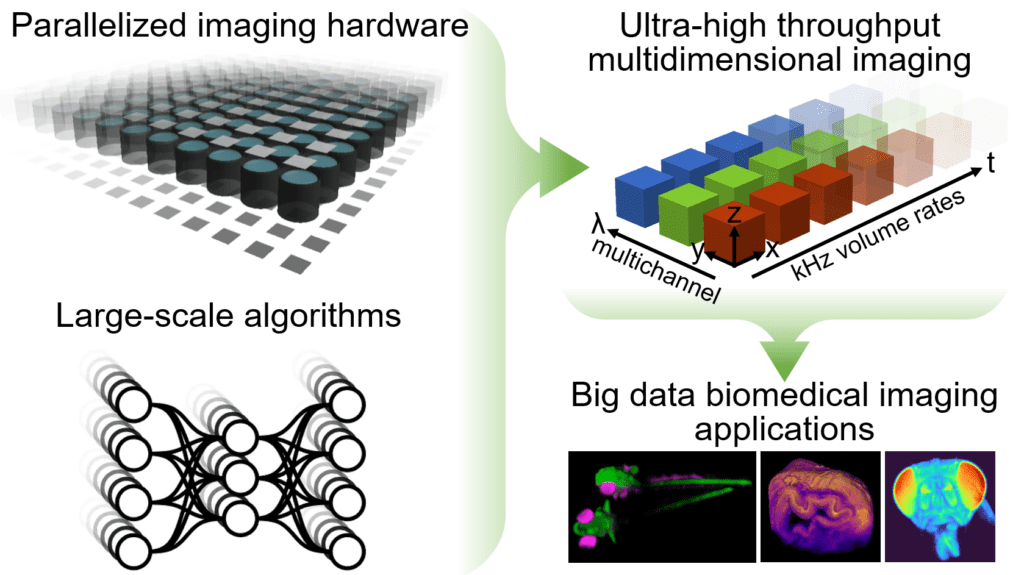
My lab develops high-throughput computational 4D optical imaging systems, leveraging highly parallelized and multiplexed imaging hardware designs and large-scale, image reconstruction algorithms. Such high-throughput imaging systems can capture gigabytes to even terabytes of image data per second, creating a wealth of data and exciting new challenges for AI/ML. In particular, AI/ML is intimately involved in all parts of the imaging pipeline, from the low-level image formation process, to big data visualization, to high-level data/image analysis for a broad range of biomedical applications.
What is the most significant scientific contribution you would like to make?
One scientific contribution I would like to make is to invent new suites of computational imaging tools that bridge the gap between microscopic neural/physiological recordings and macroscopic behavioral observation. Several spatiotemporal orders of magnitude separate these two regimes, and I believe the key will be increasing the effective throughput of our imaging systems through hardware parallelization, large-scale algorithms, and clever insights that arise through collaboration and interdisciplinary science.
What are 1-3 interesting facts about yourself?
- Many years ago, I used to be a competitive speedcuber — one who solves Rubik’s Cubes of various shapes and sizes very quickly. I have since retired.
- I am fascinated by languages and how they’ve evolved over time. In college, I briefly conducted research in a historical linguistics lab, where I applied Bayesian phylogenetic methods developed in evolutionary biology to study the numeral systems in Australian languages. Perhaps in another life, I would’ve been a linguist.