Welcome to AI in Research Consultation.
MIDAS offers one-on-one consultations to help U-M researchers apply machine learning, generative AI, agentic tools, and more to their research. Our staff scientists work with you throughout the research process, from framing your question to interpreting your results, not just helping you pick a model.
Who this is for
This consultation is open to U-M faculty and their labs, postdocs, and research staff across all schools and colleges who are exploring how to apply AI and machine learning to a research project. Researchers at all levels of experience are welcome.
Looking for a self-guided starting point instead? Check out the AI in Research Handbook.
What we cover
This is a research methodology consultation. Our staff scientists bring both AI/ML expertise and domain research experience, so the conversation is grounded in your specific field, not just the technical mechanics of a model or tool.
Consultations can touch any stage of your research, from framing your question to sharing your results. Here’s what that can look like across the research lifecycle:

- Research design: Is AI/ML the right approach for your question? We help you think it through.
- Data access & discovery: Guidance on what data you need and where to find it.
- Data preparation: Support for cleaning, structuring, or extracting information from your data, including using AI tools for this step.
- Compute resources: We help you figure out what you need (GPU type, VRAM, RAM) so you can request the right resources. (We don’t provision compute ourselves; for that, we point you to ARC/ITS).
- Baseline analysis: Feedback on your initial modeling approach.
- Advanced analysis: Support for more complex methods, including generative AI and agentic workflows.
- Custom engineering: Guidance on architecture and approach for custom pipelines or tools.
- Outputs & reproducibility: Help interpreting results and making sure your approach holds up.
- Knowledge sharing: Support thinking through how to present or document your AI/ML methods.
Examples of what this looks like in practice
- AI strategy & study design for a multi-year research grant
Description: A research team was drafting a major grant proposal to study complex biological systems and needed to define where AI methods could add rigor and value. We helped structure the overall AI integration roadmap, identified feasibility risks early, and reviewed the planned computational methodology to ensure a rigorous approach for the funding proposal.
Stages: Research design → AI strategy & grant planning - Extracting structured insights from unstructured medical records
Description: A research group wanted to extract specific diagnosis indicators from thousands of narrative health records to study long-term outcomes. We assisted in designing an LLM-based parsing pipeline, evaluating prompt strategies, and structuring validation workflows to ensure high extraction accuracy.
Stages: Data preparation → Advanced analysis - Benchmarking vision models for ecological monitoring
Description: An environmental research team needed to select an optimal open-source computer vision architecture for detecting rare wildlife species in massive image archives. We helped establish an evaluation framework to benchmark candidate detection models against annotated ground-truth data.
Stages: Research design → Baseline analysis → Outputs & reproducibility - Integrating generative summaries into multimodal pipelines
Description: A project combined high-dimensional imaging data with tabular metrics, requiring concise, human-interpretable summaries of model outputs. We advised on the end-to-end model architecture and integrated an LLM summarization step tailored for non-technical stakeholders.
Stages: Custom engineering → Outputs & reproducibility - Sizing compute and hardware specs for large-scale vision training
Description: A multidisciplinary team was scaling up deep learning workflows on a massive multi-gigabyte image collection and needed to request HPC resources. We helped estimate GPU memory (VRAM), node allocation, and training time based on model architecture and batch constraints.
Stages: Compute resources
Some researchers come to us just looking for the right collaborator, someone with the specific technical expertise your project needs. We’re happy to help make that connection too.
Looking for something else?
- Looking for help with grant boilerplate or Letters of Support? Visit Proposal Support instead.
- Looking for help with study design, sampling, or traditional statistical analysis? CSCAR@ISR is U-M’s dedicated statistical consulting service.
- Not sure where to start, or looking for something else entirely? The AI Campus Resource Map can help you find AI training, research funding, and technical support across U-M.
How it works
- Submit a request through our intake form
- A MIDAS staff scientist reviews your request
- We schedule a time to discuss your project
What to expect
A one-on-one conversation with a MIDAS staff scientist, typically lasting 30–60 minutes. Depending on your needs, this may lead to guidance on your approach, connections to collaborators, or a referral to other MIDAS resources like the AI Sandbox.
Who we are
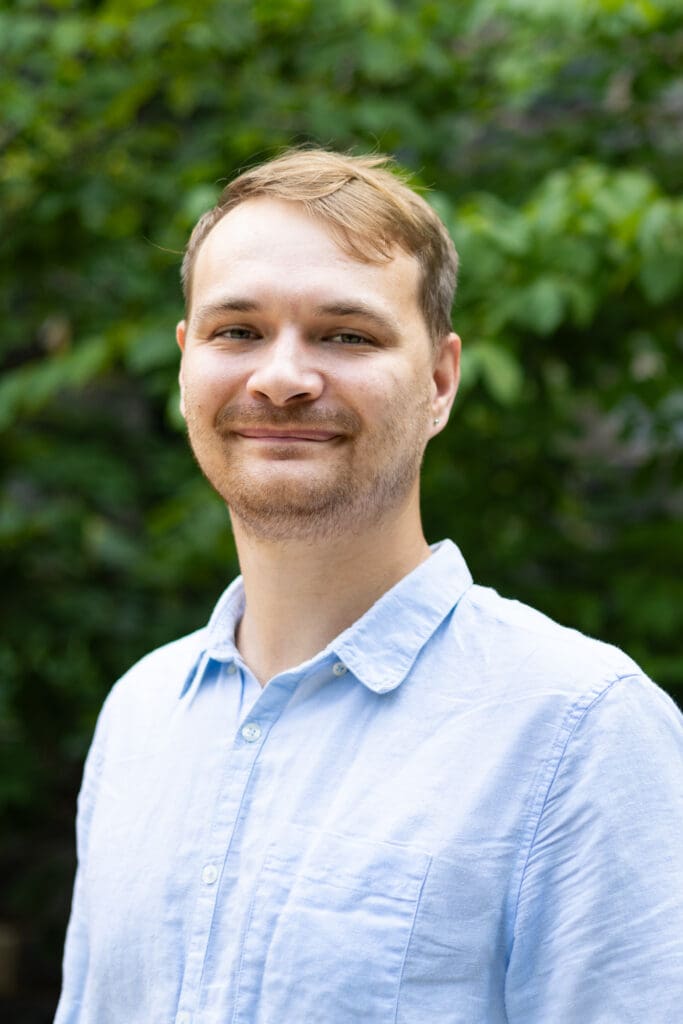
Nathan Fox, AI Scientist
Nathan is an AI Scientist at the Michigan Institute for Data & AI in Society (MIDAS). His work covers ecology, geography, the environmental sciences, urban studies, and social sciences. He applies computer vision, spatial analysis, and large language models to questions about landscapes, wildlife, cities, and how people interact with the natural world. His projects include wildlife monitoring from camera trap footage, spatial analysis of geotagged social media, mapping research trends in large publication datasets, and working with urban and housing data.
Nathan is a good fit for researchers working with spatial, image, or text data. He can help you decide whether AI suits your question and choose and evaluate existing models. He can also help you work with unconventional data sources like social media and citizen science, and design analyses that hold up under peer review.
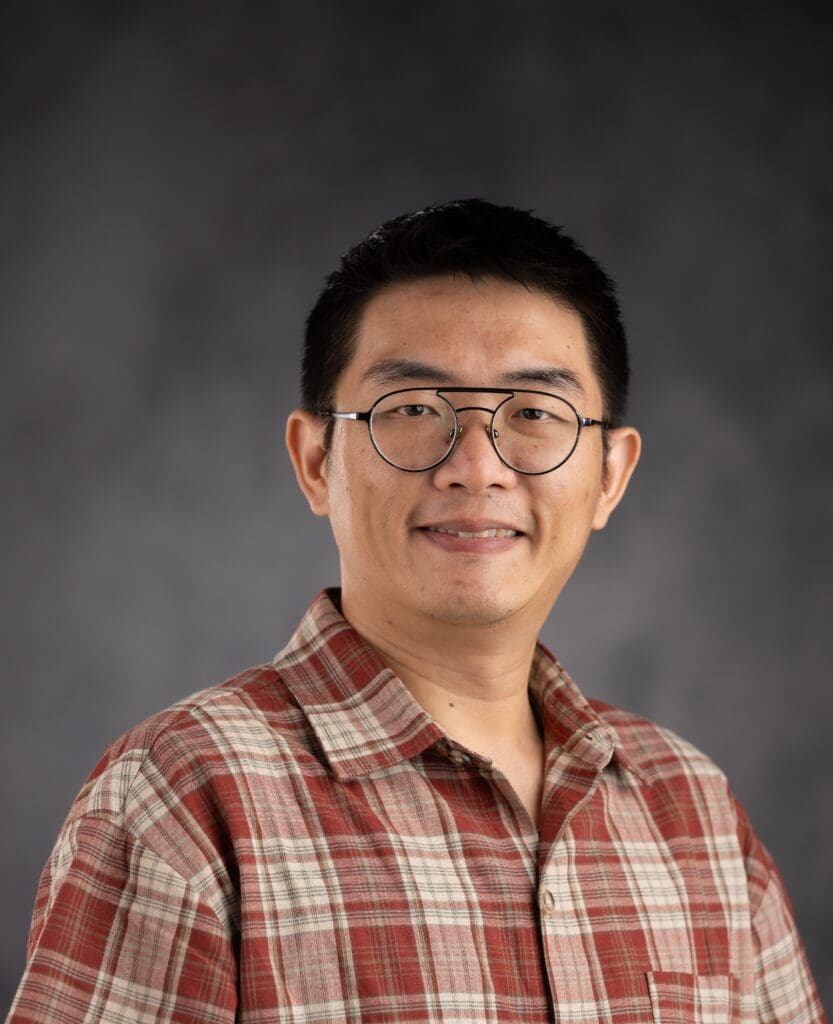
Frank Hu, Data Scientist
Frank is a Data Scientist at the Michigan Institute for Data and AI in Society (MIDAS). His work focuses on developing and applying machine learning and artificial intelligence methods to complex, high-dimensional data across interdisciplinary domains. He has over 15 years of experience in neuroimaging research, particularly in functional near-infrared spectroscopy (fNIRS) and EEG, and has led projects that integrate multimodal brain signals with advanced computational approaches. He also has broad expertise in statistical modeling, time series analysis, and building end-to-end pipelines for large-scale data, from clinical electronic health records to multimodal sensor data.
Frank is a good fit for researchers working with time series, sensor, or clinical data, or anyone building a predictive model from complex, high-dimensional data. He can help you think through modeling approaches, design a pipeline for large or messy datasets, and evaluate whether your results are robust enough to hold up under scrutiny.

Ali Bolcakan, Humanities Data Scientist
Ali is a Postdoctoral Research Fellow in Multilingual Digital Humanities in the Department of Comparative Literature, and a MIDAS postdoctoral affiliate. His research examines how texts and ideas transform as they move across languages and cultures, with a focus on non-Roman scripts and low-resource languages. As a MIDAS affiliate, he works with AI scientists to develop AI-enabled workflows for cross-linguistic humanities research, including improving text recognition for non-Roman and mixed-script documents and building computational frameworks to track how textual elements shift between languages.
Ali is a good fit for researchers working with historical, multilingual, or non-Roman script materials, or anyone whose data doesn’t fit neatly into standard NLP tools. He can help you think through text recognition challenges, cross-lingual analysis approaches, and how to adapt existing AI models to materials they weren’t originally built for.
Gokul G. Nair, Postdoctoral Assistant Professor
Gokul is a Postdoctoral Assistant Professor in the Department of Mathematics at the University of Michigan and a MIDAS affiliate. His research is in the calculus of variations and elasticity theory. He serves as the AI consultant for the Department of Mathematics, holding regular office hours and maintaining a resource hub for AI in research and teaching.
Gokul is a good fit for researchers in mathematics or related fields looking for guidance on AI tools for research or teaching.
Ask us anything
Not sure which category your question falls under, or have something else in mind? Reach out directly and we’ll point you in the right direction — whether that means scheduling a consultation, connecting you with a collaborator, or referring you to another MIDAS resource.
Email us: [email protected]