By Justin Varney
Michigan Institute for Data and AI in Society
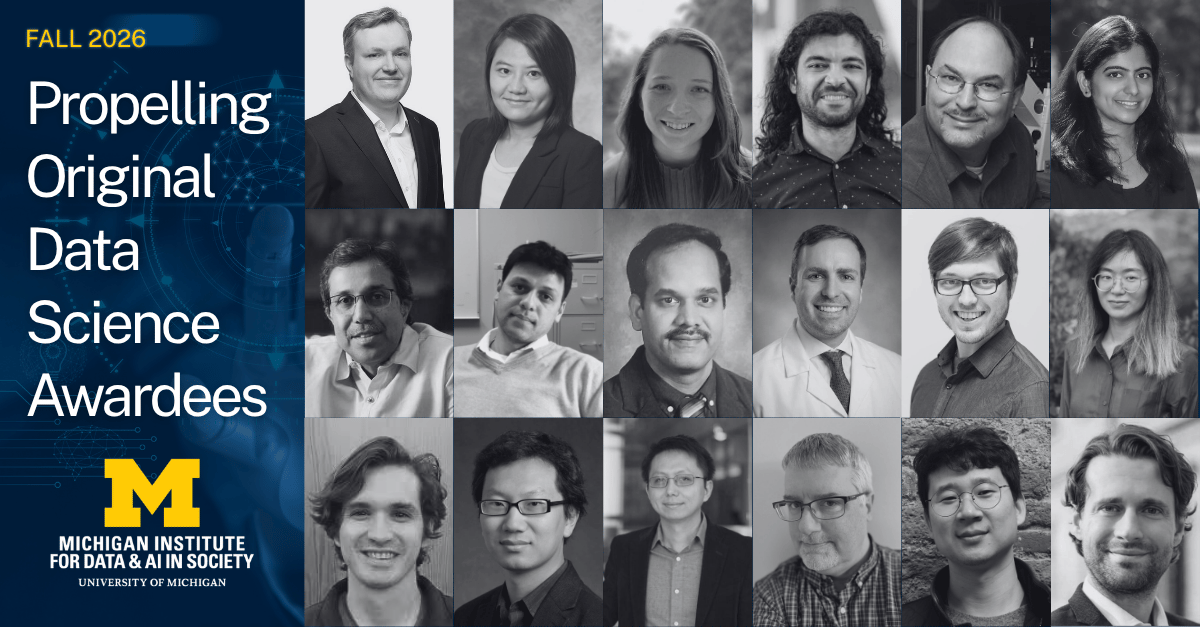
The Michigan Institute for Data and AI in Society (MIDAS) has announced the recipients of its 2026 Propelling Original Data Science (PODS) grants, supporting eight interdisciplinary University of Michigan research teams that are pushing the boundaries of data science and artificial intelligence.
The selected projects tackle some of today’s most pressing scientific and societal challenges. From developing trustworthy AI methodologies for clinical research and survey science to uncovering hidden patterns in active matter, brain-body interactions and fluid dynamics, the 2026 PODS awardees exemplify how AI is accelerating discovery across disciplines.
The annual PODS program supports bold, high-risk, high-reward research that applies or advances data science and AI while fostering new collaborations across the university. Many projects serve as catalysts for larger federally funded initiatives, helping researchers generate preliminary results and establish new interdisciplinary partnerships.
Since launching in 2016, MIDAS has invested almost $14 million in 112 faculty-led projects through 2025. With the addition of the 2026 cohort, PODS has now jumpstarted research for 120 interdisciplinary teams across the University of Michigan. Those investments have helped researchers secure more than $250 million in external funding.
“The caliber of research was truly exceptional,” said MIDAS Executive Director Jing Liu. “What distinguishes this year’s awards is how boldly these projects rethink the role of AI and data science in solving society’s most urgent and complex problems.”
The 2026 PODS awards support projects across two strategic themes that reflect MIDAS’s commitment to advancing both AI methodology and its application to transformative research.
Data Science and AI Methodology for Research
These projects develop foundational AI and data science methods that can benefit researchers across disciplines, including new approaches for survey research, interpretable computer vision, clinical data harmonization and scientific knowledge discovery.
The 2026 awardees and their schools or colleges are:
Persona-Based AI Respondents for Factorial Survey Experiments: Benchmarking Synthetic Data for Statistical Inference
Henning Silber (Institute for Social Research) and Yajuan Si (Institute for Social Research)
Constructing interpretable computer vision models from natural language
Lauren Gillespie (School for Environment and Sustainability) and Gabriel Poesia (College of Engineering)
A Foundation Model for Mode-Agnostic Discovery of Movement Patterns from Molecules to Metazoans
Nils Walter (College of Literature, Science, and the Arts), Alexander Johnson-Buck (College of Literature, Science, and the Arts), Leyou Zhang (Google), and Jieming Li (Xiamen University)
INDEX: An Evidence-Linked, Human-in-the-Loop AI Methodology for Harmonizing Clinical Research Data Across Institutions
Florian Schmitzberger (Medical School), Alex Janke (Medical School), Cong Ma (Medical School), and Alan Kay (Medical School)
Counterfactual Causal Knowledge Graphs (C-CKGs): Neurosymbolic framework for root cause analysis and actionable intervention in Smart Manufacturing, Molecular Pathway and Copper Nanoparticle Discovery
Utkarshani Jaimini (UM-Dearborn), Krisanu Bandyopadhyay (UM-Dearborn), Kalyan Kondapalli (UM-Dearborn), Suvranta Tripathy (UM-Dearborn), and Kira Barton (College of Engineering)
AI-Enabled Expansion of the Research Frontier
These projects leverage AI to tackle complex scientific questions that were previously difficult or impossible to address, opening new frontiers in physics, neuroscience and engineering.
Interpretable AI for Discovering Hidden Collective States in Programmable Active Matter
Steven Ceron (College of Engineering) and Y Z (College of Engineering)
AI-Driven Functional Magnetic Resonance Imaging and Characterization of Brain-Body Interactions
Zhongming Liu (College of Engineering / Medical School), Scott Peltier (Medical School), and Stephan Taylor (Medical School)
Beyond Simulation Echo Chambers: Training Reality-Grounded AI Flow Models from Synthetic X-Ray Radiographs
Jeong Joon Park (College of Engineering) and Ricardo Vinuesa (College of Engineering)