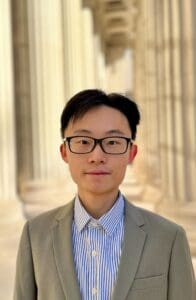
Dr. Yulun Tian is an Assistant Professor of Robotics at the University of Michigan, where he leads the Scalable Spatial Intelligence Lab. His research develops scalable and trustworthy autonomous systems that operate robustly over long periods of time without human intervention. To this end, his work applies tools from nonlinear and distributed optimization, machine learning, 3D vision, and graph theory to develop computational algorithms with theoretical guarantees and real-world robotic systems. He received the B.A. degree in Computer Science from UC Berkeley, Berkeley, CA, USA, in 2017, and the S.M. and Ph.D. degrees in Aeronautics and Astronautics from Massachusetts Institute of Technology, Cambridge, MA, USA (2019 and 2023). His work received the 2024 Best Dissertation Award from the IEEE RAS Technical Committee for Multi-Robot Systems, the 2022 King-Sun Fu Memorial Best Paper Award from the IEEE Transactions on Robotics, a 2021 Honorable Mention from the IEEE Transactions on Robotics, and a 2020 Honorable Mention from the IEEE Robotics and Automation Letters.
In my PhD research, I developed a fully distributed and resilient system to enable real-time multi-robot localization and mapping. For persistent operations in the real world, it is crucial to design the system to gracefully handle limited communication and faulty sensor measurements. To that end, I developed an efficient communication protocol that allows agents to opportunistically exchange compact visual information for collaborative localization. Furthermore, by incorporating a tool called graduated non-convexity from robust optimization, I extended my distributed perception framework to be robust against faulty (outlier) measurements during inter-robot localization. I have successfully demonstrated my system in large-scale urban missions where 8 robots traversed a total distance close to 8 km over 30 minutes. In a series of stress tests, I showed that my system can withstand up to 7s delay and 45% packet drops, and remain operational under up to 80% outlier measurements.
My past research has focused on a cross-disciplinary approach that combines theoretically grounded algorithms with practical real-world systems. I am excited to continue this cross-disciplinary approach to contribute to both the methodologies and various application domains in AI and data science.