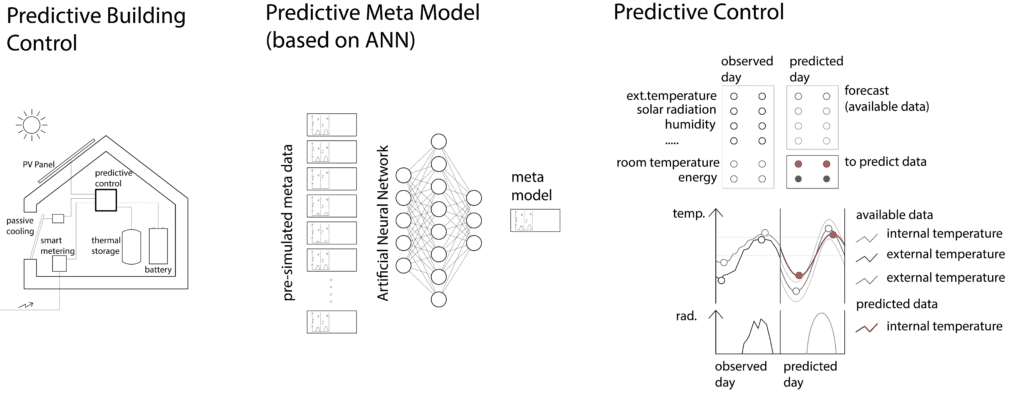
“Plug-and-Play” Building Predictive Control using an ANN generated meta-model
Predictive building control systems are building automation logics that predict future demands of a room or building. Renewable energy sources like solar energy or demand oriented energy pricing systems can be applied more efficiently when future energy needs are predicted. Storage systems like thermal storage, building integrated thermal mass and batteries can be charged more effectively.
Predictive building control systems have been introduced in the past. In most cases, these systems are based on a “white box” or “grey box” model that are based on a physical formulation of the building or room. The physical parameters of the room need to be described in detail to operate these models reliably. The definition of these parameters is challenging because of the highly individual properties of each building. For building renovation projects, technical properties for the existing building envelope are commonly not known. Expert knowledge is required to set up these physical models. This makes the definition of control parameters more time intensive and in most cases not economically feasible. A predictive control technology that can be implemented without expert knowledge is required.
A “plug-and-play” predictive controller that generates a building dynamic model that can create a room or building-specific model automatically after a short observation time is highly desirable.
A promising approach to provide predictive building control is to use data driven models that are generated by using machine learning methods like the Artificial Neural Network ANN. These data driven models approximate the physical dynamics by using measured data. However, current models still require a large amount of data that is gathered over a long observation time (several days or weeks) to provide reliable predictions.
A meta-model that uses simulated data instead of measured data can provide sufficient data. Pre-simulated data in combination with machine learning for the use in predictive building control have been applied. However, the introduced models are still highly specific for a certain building or still need a long training time for reliable operation. A “plug-and-play” controller technology that can be used universally is not introduced.
The proposed research work introduces a “plug-and-play” predictive building controller that provides accurate and reliable prediction for future room temperature, humidity level and energy demand. The novelty of the proposed technology is that it can do these predictions after only one observation (training) day and does not need any expert knowledge for implementation. It is based on a meta model (black box model) that uses pre-simulated data in combination with an ANN.
Concept 22/26, realized smart building project. Dr. Junghans was the leading engineer on the office building project Concept 22/26. The here introduced building concept goes beyond the conventional high performance building discussion by introducing an office building without any active systems for heating, cooling and ventilation. In an intensive collaboration between the worldwide known architect Dietmar Eberle and Dr. Junghans, the building envelope is improved to a level of performance where no active systems are needed any longer. The result is a building project that unifies good building design with high performance building technology. The intelligent control of the building façade is the heard of the innovative building energy concept. It controls the natural ventilation openings based on the internal carbon dioxide concentration, temperature levels and the occupant demand. The building is accomplished in the middle of July 2013. Data in extreme external temperature periods are illustrating that the room temperatures are still in the comfort field. The building achieved recognition at conferences and in journals.
Lars Junghans is an associate professor of architecture at the University of Michigan’s Taubman College of Architecture and Urban Planning. His research is focused on the development of high-performance buildings with a comprehensive view of all aspects of the building’s thermal behavior, including passive design, active strategies and renewable energy systems. His research aims to find holistic optimal solutions for the challenges of buildings in different climate zones. His interdisciplinary research work includes aspects of building automation, economics, statistics, design optimization, and building physics. Further research work includes the development of economic feasible net-zero emission buildings and the development of passive cooling strategies for informal settlements in the global south.
The development of building automation systems that improves occupant comfort and reduces cost and emissions for building operation
To bring building automation into the future by using data science and AI research
Dr. Junghans gained extensive practical engineering experience in European Architecture and Engineering firms, that are known for the planning of high-profile architectural projects. As a collaborator with architecture firm Baumschlager & Eberle, he was responsible for the comprehensive design of energy concepts at all levels of the building design and construction process. In both firms, he was responsible for the energy-concept planning of large-scale building projects across a range of typologies, such as high-rise office buildings, educational institutions, hospitals, and multi-family complexes. In an intensive collaboration with the Austrian architect Dietmar Eberle, he developed the energy concept of the award winning “22/26” office building, which was completed in 2013 and is the first office building in a cold climate without a conventional mechanical heating, cooling, and ventilation system.