My research program focuses on advanced data science methodologies in clinical neurosurgery, with the goal of improving patient outcomes, enhancing surgical decision-making, and enabling more precise, individualized care. This work leverages large-scale clinical datasets and medical imaging within a unified analytical framework to better understand disease behavior and optimize treatment strategies.
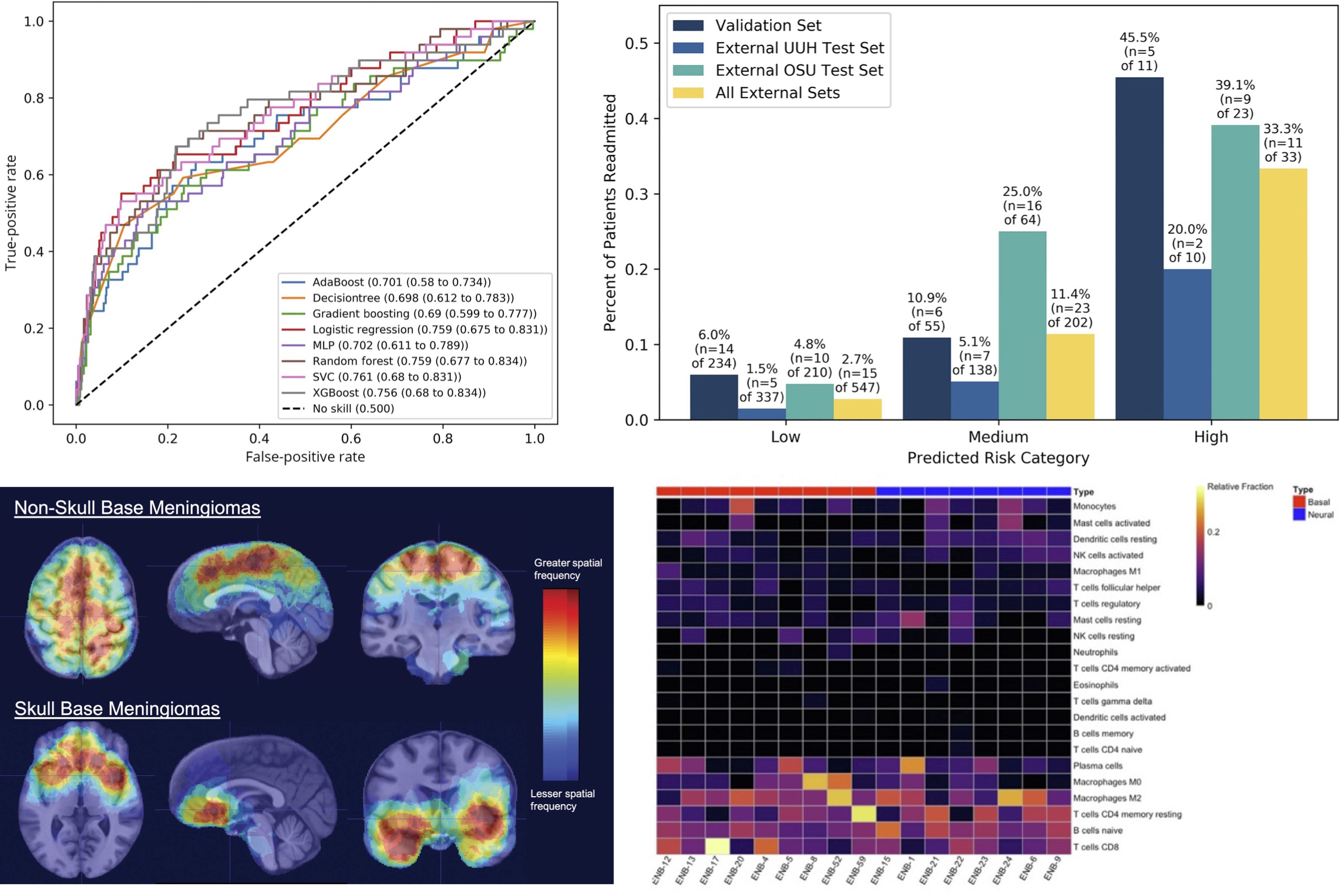
A central component of this work involves the development of robust data science pipelines for the analysis of complex, heterogeneous clinical data. Using both institutional cohorts and national datasets, we apply a combination of traditional statistical modeling and modern machine learning techniques to generate clinically actionable insights. These approaches include multivariable logistic regression, survival analysis, and causal inference methods, alongside machine learning models such as support vector machines, random forests, gradient boosting, and neural networks. Emphasis is placed on rigorous model development and validation, incorporating cross-validation, bootstrapping, and external validation to ensure generalizability. Through careful feature engineering, dimensionality reduction, and regularization, these models move beyond descriptive analysis and traditional statistical methods toward predictive and risk-stratified frameworks that can inform real-time clinical decision-making.
In parallel, our research applies advanced computational methods to medical imaging through radiomic analysis, enabling the extraction of high-dimensional quantitative features from MRI and CT data. These imaging-derived features are integrated with clinical variables to improve diagnostic accuracy, refine prognostic models, and enhance preoperative planning. By combining supervised and unsupervised learning approaches, we aim to better characterize disease phenotypes and uncover patterns not readily apparent through conventional imaging interpretation.
Please describe one or two of your most interesting projects.
More recently, our work has expanded into computational neurosurgery through collaboration with the Department of Computer Science and Engineering, with a focus on computer vision applications in the operating room. This includes the development of deep learning models for analysis of intraoperative video, incorporating techniques such as object detection and semantic segmentation to better understand surgical workflow and anatomy in real time. These efforts are directed toward creating systems capable of objectively assessing surgical performance, optimizing operative efficiency, and ultimately supporting intraoperative decision-making through real-time data integration.
Through the integration of clinical data science, imaging analytics, and computer vision, this research program aims to establish a comprehensive, data-driven framework for neurosurgical care. The long-term vision is to reduce variability in outcomes, enhance precision in treatment selection, and bring advanced computational tools directly into clinical and surgical environments to improve the care of patients with complex neurological disease.
How did you end up where you are today? (Your research journey)
My interest in the neurosciences began early during my undergraduate training at the University of California, Los Angeles, where I studied computational modeling of PET imaging in traumatic brain injury. This early exposure to quantitative approaches in neuroscience shaped my interest in integrating technology and clinical medicine. I continued to build on this foundation through an MD/PhD training pathway at New York Medical College, where my research focused on targeted therapeutic strategies for glioblastoma, an aggressive form of malignant brain tumor.
During my subsequent clinical neurosurgery training at the University of Utah and Thomas Jefferson University Hospital, I recognized a critical gap between benchside discovery and clinical implementation. This experience highlighted both the challenges of translating scientific advances into patient care and the powerful role that clinical outcomes research can play in improving care delivery at scale. My training across both basic and clinical research environments has reinforced a commitment to bridging this divide.
Through sustained collaboration with basic scientists, engineers, and clinicians, I have developed an interdisciplinary approach to research that emphasizes translation, scalability, and clinical impact. These experiences continue to inform my work and position me to build meaningful collaborations that advance innovation in neurosurgical care.
What is the most significant scientific contribution you would like to make?
I aim to transform the neurosurgical operating room into a rich, real-time data environment that can directly inform clinical decision-making and improve patient care. The operating room contains high-fidelity data—including intraoperative imaging, surgical video, and physiologic signals—that can be systematically captured and analyzed using machine learning and computer vision. By integrating these intraoperative data with existing clinical and radiologic datasets, we can build more robust, multimodal predictive models that better reflect the full continuum of care. Ultimately, my goal is to develop a work product that impacts the direction of patient care in real time, providing actionable insights at the point of surgery and creating a continuous learning system to improve outcomes.
What makes you excited about your data science and AI research?
Data science has the potential to transform healthcare by harnessing and integrating the rapidly expanding volume of clinical, imaging, and biologic data. Rather than simply revisiting established questions, modern data science approaches enable the discovery of novel patterns and insights that were not possible with smaller datasets and traditional statistical methods. This shift allows for more comprehensive, data-driven understanding of disease and supports more precise, personalized approaches to patient care.
What are 1-3 interesting facts about yourself?
I currently run a robust multi-institutional research program for undergraduates, medical students and residents seeking to learn more about research in neurosurgery