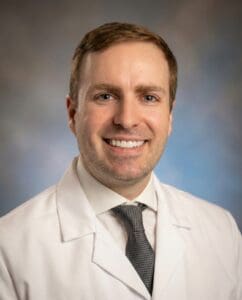
My work focuses on developing and evaluating AI tools that strengthen clinical learning and research rather than replace clinical judgment. I am particularly interested in how large language models can help clinicians better understand patient outcomes, support reflection in real-world practice, and reduce the burden of extracting meaningful information from complex clinical records. Across these efforts, my emphasis is on building practical, trustworthy, HIPAA-compliant systems that fit into existing clinical and academic workflows.
A major area of this work includes “Tell Me What Happens Next,” an AI-enabled platform that generates tailored follow-up summaries so clinicians can learn what happened to their patients after the initial encounter.
Please describe one or two of your most interesting projects.
We use LLMs to provide automated feedback to clinicians after their encounters in order to allow for self-reflected learning. Additionally, we use AI in the realm of clinical trials (and specifically cardiac arrest) to combat the data scarcity in typical clinical trials.