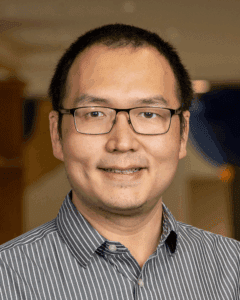
Professor Jian Kang’s research lies at the forefront of data science in biostatistics, with a strong emphasis on developing and applying advanced Bayesian and machine learning methodologies to extract insights from complex biomedical data. His work integrates statistical rigor with computational innovation to address high-dimensional, structured, and noisy data commonly encountered in public health, neuroscience, and clinical research.
A major thrust of Professor Kang’s research is Bayesian modeling for imaging data analysis, where he has introduced powerful tools for image regression, brain network analysis, and brain-computer interfaces. His development of the soft-thresholded Gaussian process (Biometrika, 2018) provides a flexible framework for spatially regularized image-on-scalar regression and has become widely cited. He further advanced the field with latent factor models for image-on-image regression (Biometrics, 2022), and latent subnetwork detection methods (Annals of Applied Statistics, 2024), enabling the discovery of meaningful patterns in neuroimaging data. These methods address spatial and network dependencies using scalable Gaussian process models, structured priors, and hierarchical Bayesian inference.
In the realm of brain network modeling, Dr. Kang has developed tools for scalar-on-network regression and distributional independent component analysis, enabling more nuanced understanding of brain connectivity across modalities like fMRI and DTI. His work significantly improves model interpretability and reproducibility in large-scale neuroimaging studies.
His research also makes impactful contributions to EEG-based brain-computer interfaces (BCIs). By developing Bayesian models for analyzing high-dimensional, multi-channel EEG signals under the P300 paradigm, his work identifies critical spatial-temporal features that support accurate and individualized neural decoding. These contributions are central to improving adaptive assistive technologies and understanding neural dynamics.
Professor Kang also leads innovations in statistical machine learning for health data, focusing on flexible, interpretable models. He has developed Bayesian graphical models for variable selection in genomics and proteomics, and nonparametric spatial models using deep neural networks (JRSS-B, 2023) to model spatially varying effects in biomedical imaging. In clinical trials, his work on machine learning–based intersection testing frameworks leverages optimization and neural networks to enhance Type I error control and decision-making efficiency.
Collectively, Professor Kang’s research combines Bayesian modeling, machine learning, scalable computation, and interdisciplinary data science applications. His methods are widely adopted in areas including mental health, neurodegeneration, oncology, and infectious disease. With over 150 peer-reviewed publications and sustained NIH and NSF funding, his scholarship continues to drive innovation at the interface of statistical methodology and biomedical discovery.
Selected References
- He J, Ma G, Kang J, Yang Y (2026) Scalable Bayesian inference for heat kernel Gaussian processes on manifolds, Journal of the Royal Statistical Society, Series B: Methodology, 88, 516–539.
- Ma T, Huggins J, Kang J (2026) Bayesian signal matching for transfer learning in ERP-based brain computer interface, Journal of the American Statistical Association (A&CS), 121(553), 100–112.
- Li Q, He K, Tsoi L, Kang J (2026) Latent class analysis with discrete failure time model, Annals of Applied Statistics, 20(1), 346–363.
- Ma G, Zhao B, Abu-Amara H, Kang J (2026) Bayesian Image-on-Image regression via deep kernel learning based Gaussian processes, Annals of Applied Statistics, 20(1), 536–559.
- Zhao B, Wang Y, Huggins J, Kang J (2026) A Bayesian reinforcement learning framework for optimizing the BCI-utility of P300 brain-computer interfaces, Annals of Applied Statistics, 20(1), 744–763.
- Zhao B, Huggins J, Kang J (2025) Bayesian inference on brain-computer interfaces via GLASS, Journal of the American Statistical Association (A&CS), 120(552), 2028–2039.
- Liu B, Zhang Q, Xue L, Song X-K P, Kang J (2024) Robust high-dimensional regression with coefficient thresholding and its application to imaging data analysis, Journal of the American Statistical Association (T&M), 119(545), 715-729 .
- Wu B, Guo Y, Kang J (2024) Bayesian spatial blind source separation via the thresholded Gaussian process. Journal of the American Statistical Association (T&M), 119(545), 422-433
- Zhang D, Li L, Sripada C, Kang J (2023) Image response regression via deep neural networks, Journal of the Royal Statistical Society, Series B: Methodology, 85(5) 1589-1614
- Ma T, Li Y, Huggins J, Zhu J, Kang J (2022) Bayesian inferences on neural activity in EEG-based brain-computer interface. Journal of the American Statistical Association (A&CS), 117:539, 1122-1133.
- Guo C, Kang J, Johnson T (2022) A spatial Bayesian latent factor model for image-on-image regression, Biometrics, 78(1):72-84.
- Kang J, Reich BJ, Staicu AM (2018) Scalar-on-image regression via the soft thresholded Gaussian process, Biometrika, 105 (1) 165-184
- Kang J, Hong GH, Li Y (2017) Partition-based ultrahigh-dimensional variable screening, Biometrika, 104(4): 785-800.
- Kang J , Bowman FD, Mayberg H, Liu H (2016) A depression network of functionally connected regions discovered via multiattribute canonical correlation graphs. NeuroImage, 141:431-441.
- Kang J, Nichols TE, Wager TD, Johnson TD (2014) A Bayesian hierarchical spatial point process model for multi-type neuroimaging meta-analysis. Annals of Applied Statistics, 8(3): 1800-1824.
- Kang J, Johnson TD, Nichols TE, Wager TD (2011). Meta analysis of functional neuroimaging data via Bayesian spatial point processes. Journal of the American Statistical Association (A&CS), 106(493):124–134.