
Derek Van Berkel
Associate Professor of Environment and Sustainability, School for Environment and Sustainability and Associate Professor of Environment, Program in the Environment, School for Environment and Sustainability and College of Literature, Science, and the Arts
Dr. Van Berkel is an assistant professor at The University of Michigan, School for Environment and Sustainability. His research focuses on understanding land change at diverse scales; the physical and psychological benefit of exposure to natural environments; and how digital visualization of data can add new place-based knowledge in science and community decision-making. He has expertise in spatial statistics, data science, big data, and machine learning. Van Berkel is currently a Co-PI on an NSF grant examining how online webtools can enable the public to co-create landscape designs for novel solutions to climate-change adaptation and mitigation in urban areas. He is also part of the NOAA funded GLISA project developing land change models to support knowledge discovery in municipalities throughout the Great Lake States. His work in AI focuses on deciphering complex sentiment from multimodal content, such as understanding image content and analyzing captions and tags posted by users, at scale. This research aims to provide objective measures of behavior and attitude for modeling diverse values and benefits of nature globally.

Jeffrey Morenoff
Professor of Sociology, College of Literature, Science, and the Arts, Research Professor, Population Studies Center, Research Professor, Survey Research Center, Institute for Social Research, Associate Dean for Research and Policy Engagement and Professor of Public Policy, Gerald R Ford School of Public Policy
Jeffrey D. Morenoff is a professor of sociology, a research professor at the Institute for Social Research (ISR), and a professor of public policy at the Ford School. He is also director of the ISR Population Studies Center. Professor Morenoff’s research interests include neighborhood environments, inequality, crime and criminal justice, the social determinants of health, racial/ethnic/immigrant disparities in health and antisocial behavior, and methods for analyzing multilevel and spatial data.
Abstract
This talk explores how artificial intelligence (AI) and geospatial data can support cities to better understand housing conditions and improve population estimates. In collaboration with the City of Detroit, researchers at the University of Michigan are developing new tools that combine street-level imagery, remote sensing data, and AI models capable of interpreting visual information about buildings and neighborhoods. These tools can identify indicators such as roof damage, structural decay, or vegetation encroachment—signals that may suggest vacancy, or blight.
Importantly, the goal is not simply to automate housing assessments. Instead, the project adopts an approach in which municipal staff and communities guide, interpret, and validate AI-generated insights. By integrating technical innovation with existing city workflows, the collaboration aims to support Detroit’s efforts to maintain accurate address records for the U.S. Census and improve housing data used for planning and investment decisions.
This work supports city efforts to improve housing and population data, while also helping strengthen communities. When residents are undercounted, cities risk losing tax revenue, federal funding, and even political representation. At the same time, urban blight and rapidly changing housing conditions make it difficult to maintain accurate records of which homes are occupied. In cities with large numbers of vacant, abandoned, or deteriorating structures, some inhabited homes may be mistakenly classified as vacant, leading to inaccurate population estimates and challenges for housing policy and neighborhood revitalization efforts. More broadly, this work highlights how partnerships between universities and local governments can support cities adopting AI tools responsibly while strengthening data-driven decision-making
Parking/Accessibility
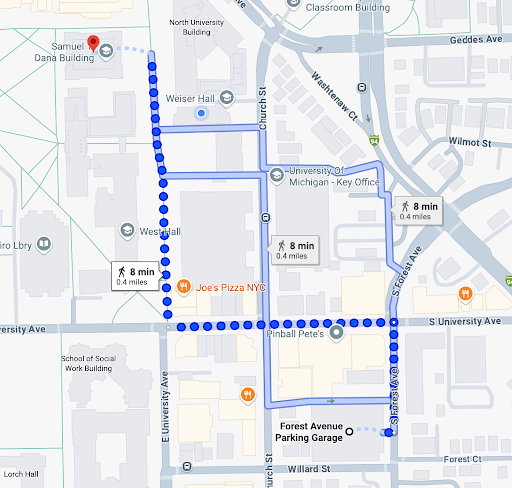
The closest public parking garage to the Samuel T. Dana building is the Forest Ave. Parking Garage located at 650 S Forest Ave, Ann Arbor, MI 48104.
Forest Ave. Parking Garage located at 650 S Forest Ave, Ann Arbor, MI 48104.
For guidance on directions, U-M faculty/staff parking, and accessibility, please visit: https://maps.studentlife.umich.edu/building/samuel-trask-dana-building
This series is co-sponsored by



Please reach out to Ben Surgalski ([email protected]) with any questions.