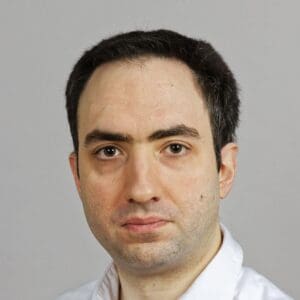
Dimitrios Simatos is a Postdoctoral Research Associate in the Department of Aerospace Engineering at the University of Michigan. The broad aim of his research is to use artificial intelligence to accelerate the design, fabrication, and characterization of novel materials and devices. Rather than relying exclusively on conventional, manually conducted research and development, he works with a robotic “self-driving laboratory” that can autonomously formulate and characterize solution-processed materials.
A self-driving laboratory is more than an automated experimental platform. It combines robotic experimentation with machine-learning algorithms that select the next experiment based on data collected during previous experiments. Within objectives and constraints established by researchers, the system can iteratively conduct experiments, analyze the resulting data, update its models, and determine which experiment would be most informative to perform next. Such systems may also incorporate simulation results and data extracted from the scientific literature.
One such prototype self-driving laboratory is housed in the University of Michigan’s Department of Aerospace Engineering. It currently focuses on the autonomous formulation and characterization of non-aqueous liquid battery electrolytes. The system prepares electrolyte samples by combining salts and solvents at different concentrations and then measures properties such as density, viscosity, and ionic conductivity. These experimental results are used to update machine-learning models, which select subsequent experiments through a process known as active learning.
The motivation for AI-guided experimentation and self-driving laboratories is to shorten the materials-discovery and development cycle, which can take more than a decade from initial concept to practical deployment. This challenge is particularly significant for battery electrolytes because they must simultaneously satisfy several chemical, electrochemical, and physical requirements. Furthermore, the properties of liquid mixtures can arise from nonlinear interactions among their components and therefore cannot always be predicted from the properties of the individual ingredients. The vast number of possible combinations of salts, solvents, concentrations, and additives, together with these nonlinear mixing effects, creates a large experimental space that would be extremely time-consuming to explore through manual experimentation alone.
As a MIDAS postdoctoral affiliate, Dimitrios will have the opportunity to further develop his expertise in machine learning and artificial intelligence, data management, rigorous analytical methods, and reproducible research workflows. He also hopes to exchange ideas with other MIDAS members and establish connections that may lead to new collaborations, research directions, and educational workshops.