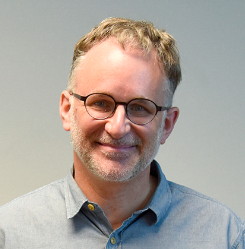
I am a physical oceanographer. Together with my group members at the University of Michigan, and external collaborators, I investigate tides, currents, and eddies. Our primary tools are numerical models, often run at large supercomputer centers. We compare our model results to observations from in-situ instruments and satellites. I have been a member of the Science Definition Team and Science Teams for the NASA/CNES Surface Water Ocean Topography (SWOT) mission since 2013. As I am in a broad earth science department, I sometimes get pulled in to interesting interdisciplinary earth science projects such as tsunamis, deep-time Earth-Moon evolution, and others. Together with numerous collaborators in Africa and elsewhere, I have helped to instigate a small but growing network of ocean science summer schools in West and East Africa.
Please describe one or two of your most interesting projects.
Here are three of our interesting multidisciplinary projects:
We simulated the 4.5 billion year history of the Earth, Moon, and tides. See https://doi.org/10.1029/2021JE006875. We are currently conducting follow-up work on this problem.
We examined the potential effect of the tidally-induced slowdown in Earth’s rotation on the development of photosynthesis and oxygenation. See https://doi.org/10.1038/s41561-021-00784-3.
We simulated the megatsunami resulting from the asteroid impact that killed the dinosaurs. See https://doi.org/10.1029/2021AV000627. We are currently conducting follow-up work on this problem.
See also the scientific contributions section below.
How did you end up where you are today? (Your research journey)
As an undergraduate at University of Michigan, I majored in math and physics. I joined the Peace Corps after that, and the connections developed there led to the ocean science summer schools described above. I then did a PhD in the MIT/Woods Hole Oceanographic Institution Joint Program, followed by a postdoc in the Princeton University/NOAA Program in Atmospheric and Oceanic Sciences. I was a research scientist at The University of Texas at Austin for 3.5 years, and an assistant professor at Florida State University for 1.5 years, before joining the faculty at Michigan.
What is the most significant scientific contribution you would like to make?
My collaborators and I pioneered high-resolution global models that include both atmospheric and tidal forcing. See our first papers on the topic: https://doi.org/10.1016/j.ocemod.2010.01.007 and https://doi.org/10.5670/oceanog.2012.38, as well as these reviews: https://doi.org/10.17125/gov2018.ch13 and https://doi.org/10.1016/j.pocean.2022.102824. There are numerous applications of such models. Most of my grants, from multiple federal agencies, are related to this work.
We have used are are using such models to make three-dimensional maps of ocean mixing, examine the impacts of climate variability on tides, make internal tide corrections for satellite missions, better understand the development of the internal gravity wave continuum spectrum, and better understand the impact of internal gravity waves on naval operations.
The Coastal Ocean Environment Summer School In Nigeria and Ghana (COESSING), which has been running for one week every year since 2015, is described on our website (https://coessing.org) and in this paper: https://doi.org/10.5670/oceanog.2025.116. We have also begun a sister school in East Africa, and ran it in Kenya in 2025 and Tanzania in 2026. See the in-development webpage here: https://coes-wio.vercel.app/, which will soon migrate to https://coes-wio.org. Our schools helped to inspire a Francophone sister school (https://www.ggosss.org/).
What are 1-3 interesting facts about yourself?
I am a former Peace Corps Volunteer. I taught secondary school math and physics in northern Ghana. The connections developed during Peace Corps ultimately led to the development of our ocean science summer schools in Africa.
I love travel, and have been to all of the continents except Antarctica. Hopefully I will get there someday.