
Xiaofan Liang
Assistant Professor of Urban and Regional Planning, Taubman College of Architecture & Urban Planning
Bio
Xiaofan Liang is an Assistant Professor of Urban and Regional Planning at Taubman College of Architecture & Urban Planning, University of Michigan – Ann Arbor. Liang is also affiliated with Michigan Institute for Data & AI in Society, UM Center for the Study of Complex Systems, and Science, Technology, and Public Policy Program. Liang is passionate about helping cities better understand and govern the complex networks and technologies that shape urban life. Liang’s research examines how network infrastructures such as mobility, social, and digital systems, as well as emerging AI technologies, shape, support, or hinder how cities function, how they are governed, and how residents experience everyday urban life.
Abstract
Zoning codes shape what can be built and where, yet their information remains buried in thousands of locally written documents that are difficult to search, compare, and analyze at scale. Zoning regulations present four particular challenges: they are heterogeneous, as jurisdictions organize and express similar rules differently; interdependent, as provisions interact through definitions, exceptions, overlays, and cross-references; multimodal, as requirements appear in text, tables, maps, and diagrams; and partly judgment-dependent, as some provisions require human interpretation and discretion.
This talk presents a work-in-progress project that develops an agentic AI approach to transform zoning documents into structured, traceable regulatory data. Drawing on applications across more than 1,100 Michigan zoning documents and preliminary evaluations against human-coded data, I will discuss what AI can and cannot reliably interpret, where errors arise, and what these challenges reveal about the limits of computational reasoning over zoning regulations. The talk concludes by exploring a broader vision of computational zoning: making land-use regulations more accessible, interpretable, and comparable, and ultimately supporting inquiries across planning intentions, zoning rules, development scenarios, and community outcomes.
Parking/Accessibility
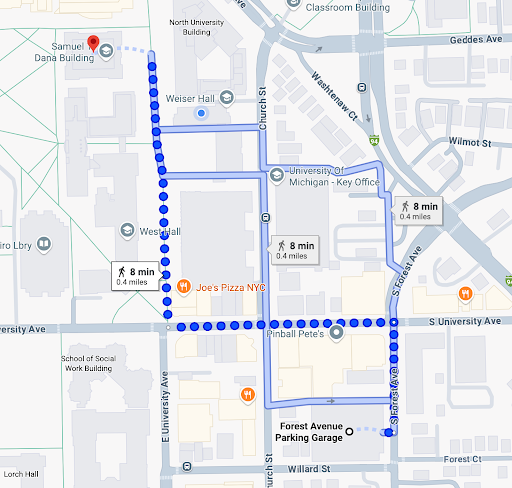
The closest public parking garage to the Samuel T. Dana building is the Forest Ave. Parking Garage located at 650 S Forest Ave, Ann Arbor, MI 48104.
Forest Ave. Parking Garage located at 650 S Forest Ave, Ann Arbor, MI 48104.
For guidance on directions, U-M faculty/staff parking, and accessibility, please visit: https://maps.studentlife.umich.edu/building/samuel-trask-dana-building
This series is co-sponsored by

Please reach out to Ben Surgalski ([email protected]) with any questions.