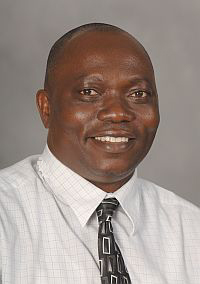
I have devoted several years to developing MD models that provide an understanding of the molecular behavior of Graphene (GNP)-based epoxy composites. This collaborative research is focused on advancing multiscale modeling using the Large-scale Atomic Molecular/Massively Parallel Simulator (LAMMPS) simulation package. The work has relied on the availability of parallel processing arrays and my programming experience in conduction with other collaborators in this kind of multiscale modeling. These studies involved the processing of output data using Microsoft Excel. The research outcome of my work in GNP-base epoxy composites has been widely shared with other educators, researchers, and engineering professionals, and many researchers have cited the simulation work and employed ideas to further advance composite materials research and their associated technologies
Please describe one or two of your most interesting projects.
In my earlier work, I have worked and developed analytical solutions for composites joints Structures, in which I worked to identify important variables that can optimize the strength of composite joints. Designers of composite joints for aerospace and automotive industries have utilized my ideas to further optimize the performance of these structural systems for aerospace, automotive, and military applications..
I have also worked in collaboration with other researchers on computational modeling and simulation of advanced materials, including pure epoxy networks, GNP/epoxy, CNT/epoxy, and GNP/carbon fiber/epoxy nanocomposites, using Molecular Dynamics, micromechanics, and multiscale methods.
How did you end up where you are today? (Your research journey)
I earned my BSE and MSE in mechanical engineering from the University of Ilorin, Nigeria. I also earned PhD in mechanical engineering from the Howard University. I have worked in research collaboration with the Michigan Technological University and the National Aeronautic Space Administration. I am currently a professor in the Department of Mechanical Engineering at the University of Michigan-Flint.
What is the most significant scientific contribution you would like to make?
I have the desire to computationally develop high-performance featherweight materials using microstructural modelling and simulation, and material modeling.
What makes you excited about your data science and AI research?
I am excited about the opportunity to couple molecular dynamics with AI to accelerate computational discovery in materials modelling and simulation.
What are 1-3 interesting facts about yourself?
- I am very passionate about computational materials simulation and modeling with the goal of developing lightweight and high-performance materials
- I am a goal oriented person
- I am a family oriented individual