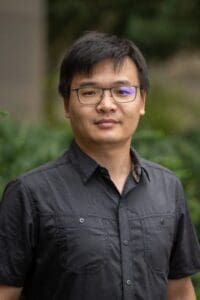
Feige Wang is an observational astronomer with broad research interests in observational cosmology and extragalactic astronomy. He is leading efforts to study the environments and dark matter halos of the earliest supermassive black holes and galaxies, to find and characterize protoclusters and large-scale structures in the early Universe, to conduct deep galaxy redshift surveys using the James Webb Space Telescope (JWST) and multi-wavelength follow-up observations, and to map the history and morphology of Cosmic Reionization.
He has been passionate about mining large astronomical survey datasets to discover some of the rarest objects in the Universe (e.g., quasars) and is particularly interested in applying statistical inference and machine learning techniques to astronomical data. He is also interested in time-domain surveys as the Rubin Observatory begins its science operations and we’re entering a golden age on studying high-redshift dynamic universe with JWST and Roman. Dr. Wang is a member of the Euclid Consortium, the LSST AGN Working Group, and the Roman Cosmic Dawn Science Investigation Team, and he is excited about collaborating with others who share an interest in mining big data from these next-generation astronomical surveys.
What makes you excited about your data science and AI research?
We are entering a new era in astronomy with the launch of three major surveys: the Euclid mission, the Rubin Observatory, and the Roman Space Telescope. These facilities will deliver high-quality imaging and spectroscopy across optical to near-infrared wavelengths, capturing detailed information on more than 10 billion celestial objects throughout cosmic time and generating over 20 terabytes of data each night, far beyond the capacity of human inspection. Rapid advances in data science and AI techniques will play a critical role in driving astronomical discoveries in the next decade and beyond. If you are also excited about mining these large datasets, whether to discover rare objects, explore time-domain science, or apply statistics, machine learning, and AI techniques to astronomical data, please feel free to reach out.