AI is now embedded in everything from sepsis prediction and credit scoring to public policy and online platforms. MIDAS is building the foundations for responsible AI and enabling responsible practice through research, training, policy partnerships and human-centered AI.
The Epic Sepsis Model was supposed to be a breakthrough. Embedded in electronic health record systems at hundreds of hospitals, the AI tool promised to detect sepsis, a condition that kills more than 250,000 Americans each year, early. This is an urgent task for health care staff at hospitals where every hour of delayed treatment raises mortality risk. Epic Systems reported accuracy rates between 76 and 83 percent. Hospitals adopted the model widely, trusting that real-time alerts would help clinicians intervene sooner.
Then researchers at Michigan Medicine decided to validate it independently.
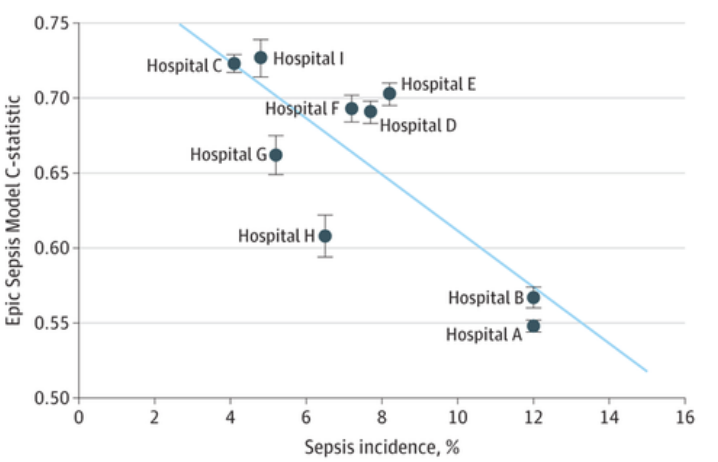
Figure from Patrick G. Lyons et. al (2023) – Association Between Hospital-Level Sepsis Incidence and Epic Seps is Model C-Statistic Across 9 US Hospitals in a Network. Each hospital is represented by a blue point (A through I), with 95% CIs represented by vertical bars. The diagonal line represents the line of best fit among hospitals A through I.
In a 2021 study of nearly 40,000 hospitalizations, the model missed 67% of sepsis cases. It flagged only 7 percent of patients that clinicians had not already identified as high risk, while generating alerts for nearly one in five hospitalized patients, which overwhelmed staff with alarm fatigue. A follow-up study spanning more than 800,000 patient encounters across multiple hospitals showed wildly uneven performance, with the model working the worst at hospitals that serve sicker, more complex patients.
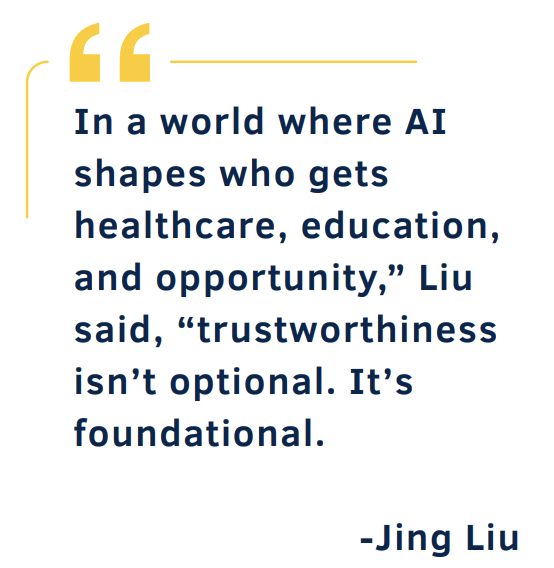
“Such wake-up calls have been sounding for many years,” said Jing Liu, Executive Director at MIDAS. “And with researchers rushing into data- and AI-intensive research, the issue of research rigor, reproducibility and the trustworthiness of science is never more important.”
“The reproducibility crisis”, the widespread phenomenon that research studies fail to be reproduced or validated which damages the trustworthiness of science, is something MIDAS has been trying to address for years through the development of training programs and supporting research to improve research.
Why trustworthiness matters
AI now shapes decisions across nearly every consequential domain: healthcare, hiring, credit, education, criminal justice, public policy, and scientific discovery itself. A single flaw in a widely deployed model can do serious harm to people and erode trust in institutions that rely on automated systems. In academic research, the rush to publish often leads to hastily done research without proper validation or the proper sharing of data and models. Such issues are exacerbated as increasingly more researchers rely on data that they did not collect themselves and models that they did not train themselves.
“We’re in a moment where AI and data science capabilities are advancing incredibly fast,” said Liu, “but our ability to rigorously use such capabilities hasn’t kept pace. That gap is dangerous.”
The knowing–doing gap
By the late 2010s, there was broad consensus about what responsible data science should involve: fairness, transparency, accountability, robustness, privacy. Professional societies published principles. Companies released ethics statements. Policymakers issued guidelines.
But principles alone can’t change practice.
Many research teams lacked concrete tools and workflows to implement best practices consistently. Ethical reviews, when they happened, often came after data were collected, models trained, and decisions locked in. Small changes in preprocessing or modeling choices could produce very different results, yet were often not documented.
“Saying you care about fairness and actually building fair systems are very different things,” said H. V. Jagadish, MIDAS Director from 2019 to 2025. “You need methods, tools, training, and institutional structures that make doing the right thing the default, not a heroic extra effort.”
MIDAS set out to close that gap by treating responsible AI as culture.
Building the culture
Responsible research is one of MIDAS’s core focus areas, running through all of the institute’s work rather than sitting on the margins and spanning reproducibility, data equity, ethics, and human centered design.
In 2020, MIDAS built a Reproducibility Hub, an online repository of tools, templates, and best practices contributed by researchers across the university, including those who won the MIDAS Reproducibility Challenge, to highlight exemplary work and provide models others can follow.

With such work as the foundation, MIDAS started DAIR³: Data and AI Intensive Research with Rigor and Reproducibility, a national NIH-funded multi-university collaboration. DAIR³ combines intensive bootcamps with year-long follow-up mentoring that help faculty, staff, and advanced trainees nationwide incorporate new skills and mentality into their research and teaching. Participants learn how to document data provenance, design reproducible workflows, develop robust machine learning models and statistical analysis, and rigorously compare results from multiple studies. The goal is not awareness but habit change.
“We’re trying to redefine what normal practice looks like,” Jagadish said. “If you train enough people and give them tools that make rigor easier, it becomes the standard rather than the exception.”
Data equity and FIDES
Trustworthy AI also depends on equitable data practices. Jagadish led the Framework for Integrative Data Equity Systems (FIDES), a $2.5 million NSF-funded, multi-institution effort.
FIDES focused on identifying inequities in data collection, modeling, and deployment to design systems that actively counter those inequities rather than amplifying them. The work spanned domains including health, mobility, and public services.
“Data equity isn’t just about representation,” Jagadish said. “It’s about understanding how data and algorithms shape power, to build systems that work against existing imbalances.
From research to practice
MIDAS’s commitment to trustworthy AI extends beyond principles into practice through strategic partnerships and targeted research investment. A cornerstone of this work is its collaboration with Microsoft, launched in 2024 to advance research and policy solutions for responsible AI. Research projects funded by Microsoft’s Office of Responsible AI span both technical and socio-policy dimensions of responsible AI. Researchers carry out work on human–AI system design, building equitable predictive modeling, developing community-inclusive innovation frameworks, enabling appropriate reliance on generative AI, creating interventions to address online harms such as non-consensual intimate media, and building data-driven tools to inform public decision-making in areas like infrastructure and climate policy.
“Together, these projects form a pipeline from research to real-world impact by guiding responsible system design, improving governance, and strengthening society’s capacity to adopt AI thoughtfully.” Said Liu.
By connecting academic research to policy and practice, the MIDAS–Microsoft collaboration demonstrates how university–industry partnerships can help ensure that AI development is grounded not only in technical excellence, but also in accountability, equity, and public trust.
Human-centered AI
Even statistically fair and robust systems can fail if people don’t understand when to trust them.
Nikola Banovic, MIDAS Associate Director and Associate Professor of Computer Science and Engineering, designs explanation mechanisms that help users build accurate mental models of AI systems to understand both their strengths and limits. Vera Liao, Associate Professor of Computer Science and Engineering, studies AI transparency from an Human-computer Interaction perspective, asking how explanations can be designed to support real decision-making rather than overwhelm users with technical detail.
Human-centered AI work connects directly to responsible AI goals. A system might be statistically fair and technically robust, but if people can’t understand how it works or don’t trust it, it won’t be used appropriately. Conversely, a system that’s presented with misleading explanations or overconfident predictions can lead people to trust it in situations where they shouldn’t.
Together, their work underscores a core MIDAS principle: trust is relational, not just statistical.
A different kind of breakthrough
MIDAS is betting on a different narrative about AI progress. Not just models that are faster or more accurate, but also systems that are fairer, more transparent, and more robust.
The Epic Sepsis Model story could have ended badly. Instead, independent validation exposed its limits, sparked changes in how hospitals evaluate clinical AI, and reinforced the need for rigorous testing across settings.
That outcome wasn’t inevitable. It happened because Michigan researchers had the tools, training, and institutional support to ask hard questions, and because that expectation was part of the culture.