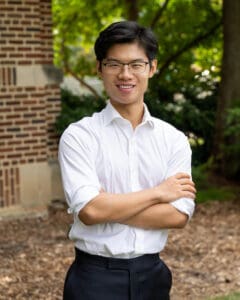
I study how abstract linguistic knowledge—mostly phonological but also morphosyntactic—is acquired by children and machines.
Please describe one or two of your most interesting projects.
- Engram: this project aims at building an interpretable language model that captures nonlocal dependencies while maintaining its restrictiveness—super efficient on small data and grounded on cognitive (neuro-)science.
- BabyLMs: this project aims at evaluating language models capability when trained on small datasets similar to what human children are exposed to, and identify the pain point for modern LMs so that we can provide solutions to (1) create developmentally plausible LMs; (2) understand the learning trajectory of LMs (3) provide insight into human language acquisition.
How did you end up where you are today? (Your research journey)
I had a lot of wonderful, extremely smart mentors!
What is the most significant scientific contribution you would like to make?
Building a computational theory of language from first principles, which potentially leads to the next-gen AI that is safer, more efficient and human-like.
What makes you excited about your data science and AI research?
We are at a turning point in the history, as developments across scientific subfields (e.g. linguistics, psychology, neuroscience, computer science, etc.) converge on a computational account of human cognition, language, and behavior. This is not the end but the beginning of a new era—one that reengages foundational scientific questions through general-purpose machine learning algorithms and computational models more broadly.
What are 1-3 interesting facts about yourself?
I’m in love with classical music, especially symphonies and concertos. Listening to my favorite classical CDs (usually borrowed from libraries) is my daily routine from 6 to 9pm.