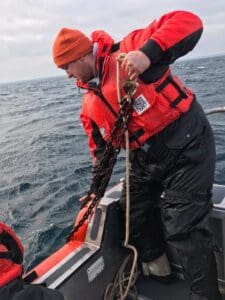
David Cannon’s research program at CIGLR is focused on physical limnology in the Great Lakes, with an emphasis on modeling and observing the connected lake system. His research is primarily aimed at developing operational lake models, including the next-generation Great Lakes Operational Forecast System (GLOFS), which is designed to provide real-time and 5-day forecast guidance for water levels, currents, temperatures, and ice cover in Lakes Superior, Michigan, Huron, Erie, and Ontario. These numerical models support coastal management, navigation, and disaster response across the region. David is also interested in understanding climate variability in the Great Lakes, with research focused on quantifying long-term changes in atmospheric forcing, lake temperatures, and ice cover. This work utilizes a suite of environmental data techniques, including deterministic coupled lake-atmosphere simulations, advanced analysis of historical observations, and deep learning approaches.
How did you end up where you are today? (Your research journey)
David grew up in northwest Indiana, spending his summers fishing and swimming in Lake Michigan. He followed his passion for water and environmental science to Purdue University, where he completed his PhD in Civil Engineering. While at Purdue, David studied turbulent mixing and and invasive mussels in Lake Michigan. This provided a perfect opportunity to spend many hours on the water, far from the perils of emails and administrative meetings. After a brief stint studying oyster reefs and mangrove fringes at the University of Central Florida, David returned to the University of Michigan to continue his work on Great Lakes science.